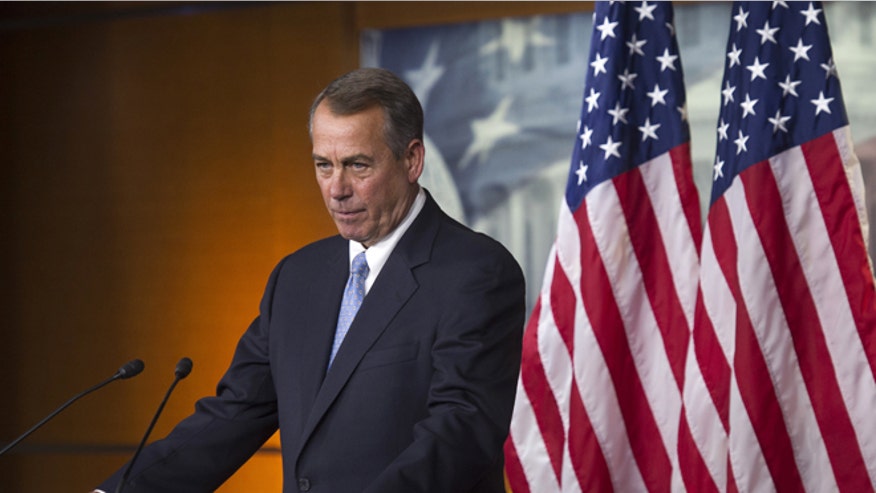
Reports of possible deal on DHS funding reignites chatter about Boehner ouster

Multiple reports that House Speaker John Boehner has cut a deal to pass a long-term funding bill for the Department of Homeland Security without ties to rolling back President Obama’s executive action on immigration has reignited rumblings about a Boehner coup.
The deal was purportedly struck as the House agreed late Friday night to fund the agency for seven days to avoid a partial shutdown.
At least one congressional aide said the deal between Boehner and House Minority Leader Nancy Pelosi was to get enough Democratic votes in the Republican-led chamber to avoid the shutdown at midnight Friday, in exchange for Boehner’s promise to allow a vote next week on a long-term funding bill “clean” of the immigration issue.
Boehner spokesman Mike Steel told Fox News that such a deal doesn’t exist. Pelosi’s office has neither confirmed nor denied such a deal.
The calls for Boehner’s ouster appear to be coming mostly from the 50-plus, most-conservative members who formed the new Freedom Caucus. And they appear to be growing more restless.
The number of House Republicans who voted Friday night against the 7-day funding for DHS was 55, compared to 52 who voted against the failed 3-week funding bill earlier in the evening.
The party’s most conservative wing tried unsuccessfully in January, at the start of the 114th Congress, to replace Boehner.
A dozen House Republicans either voted for somebody else or didn’t cast a vote.
Ousting a House speaker is unprecedented. Electing a House speaker and thus trying to remove one is a “privileged” effort in the lower chamber. Privileged resolutions can skip to the front of the legislative line and not be sidetracked by leadership.
Jefferson’s Manual, crafted by Thomas Jefferson and still used today as one of the main sources for House operations, says the following:
“A Speaker may be removed at the will of the House and a Speaker pro tempore appointed.”
But it’s unclear how that process happens since no speaker has ever faced a challenge in the middle of the Congress.
Boehner opponents could write a “privileged” resolution declaring that the speakership is vacant. The House would then vote on that motion or possibly vote to table or kill it.
The closest the House ever got to this scenario came during the failed coup attempt in July 1997 on House Speaker Newt Gingrich, R-Ga.
They tried to bring forth such a privileged “vacancy” resolution, but the coup fizzled after Gingrich learned of it and those who tried it realized they didn’t have the votes.
Fox News’ Chad Pergram contributed to this report.

Comments

Popular posts from this blog

Qualcomm teases Snapdragon 820 while launching Sense ID fingerprint scanner

Qualcomm has announced a new fingerprint scanner destined for smartphones, called Sense ID , which uses ultrasonic sound waves to map the surface of your finger. Previous methods of fingerprint recognition used high-resolution capacitive sensors, but switching to ultrasonic sensors has a number of benefits. Firstly, these types of sensors are more accurate than their capacitive counterparts, as they're able to recognize the pores and ridges on your finger for increased security. They're also not as susceptible to moisture as previous sensors, and can work through glass, sapphire, plastic and even metal. Sense ID sensors will be compatible initially with Snapdragon 810 and 425 SoCs, although you'll eventually see them supported across the entire range of Snapdragon 400, 600 and 800 series SoCs.  As well as launching Sense ID, Qualcomm has teased their upcoming flagship SoC,  the Snapdragon 820 . Qualcomm has designed their own 64-bit capable ARMv8 cores for this SoC...

First Take: Back to the future — Nasdaq 5000 circa 2015

The once-deflated Nasdaq has fully reflated. For the past 15 years, chatter about Nasdaq 5000 was mainly in the past tense, a historical remnant of the dot-com stock bubble era. But today, for the first time since March 2000, the Nasdaq composite — powered by Apple, the world's most valuable company and maker of the iPhone, and a fresh wave of innovation in social media, digital technology and biotech — is back above 5000 and very much alive in the current events debate. Way back when, on March 9, 2000, when the Internet was in diapers and investors were betting that the World Wide Web would be a moneymaking investment of epic proportions, the Nasdaq and its army of newly minted dot-com stocks skyrocketed to its first close above 5000, up an eye-popping 111% from a year earlier. At the time, "Nasdaq 5000" elicited a 1969 "man on the moon"-type awe from investors ranging from Wall Street titans to taxi drivers and hairdressers who viewed "Net stocks...

GOOGLE IS PLANNING TO OFFER ITS OWN CELLULAR DATA NETWORK

BY  DANIELLE HOWE Move on over, traditional phone plans. Following weeks of rumors that it would introduce its own cell-data network,  Google  confirmed reports that it will be indeed taking on the endeavor.  The search-engine giant made the announcement at the wireless show in Barcelona, Spain, on Monday that it will sell data plans for smartphones and tablets in the next coming months. It hasn’t been revealed which wireless carrier would be hosting the Google service, but various reports suggest that Sprint and T-Mobile are the frontrunners. The move comes as a game changer for the wireless network market, though Google insists that its plan is not to become a huge competitor in that field. “We don’t intend to be a network operator at scale,” said Sundar Pichai, Google’s senior vice president of products. “Our goal here is to drive a set of innovations which we think the ecosystem should evolve and hopefully will get traction.” The decision co...